
Your Guide to Commercial Roof Life Expectancy
Your roof plays a critical role in protecting your facility’s operational security. From weather to accidental punctures and cuts associated with rooftop foot traffic, your roof is the first line of defense against a range of threats. For that reason, it’s important to know that your roof is in good health throughout its useful life.
Age can be one indicator, but that may not tell the whole story, and different types of membrane tend to deliver varying service lives. Without proper inspection and proactive maintenance practices, you may not even notice a problem until it results in a leak or other obvious form of failure. That can cost you, potentially leading to a shortened service life and other consequential damages to your facility…and ultimately disruption to your operations.
In this blog, our experts explore how you can best predict the life expectancy of your roof system based on proactive regular maintenance practices, historical and anticipated repair needs, membrane choice, and more. Let’s get started:
Maintenance Best Practices and Evaluating Roof Condition
Your roof will require attention throughout its life—and the more proactive you are about roof maintenance, the longer your roof should serve you.
For example, commercial roofs should generally be inspected a minimum of two times per year—typically in the fall and spring. These are good opportunities to evaluate any potential stresses resulting from the harsher summer and winter months. It is also best practice to inspect your roof following an extreme weather event, where additional debris or wind damage is more likely to occur.
The purpose of these inspections is to evaluate general membrane condition while identifying any problems that might require your attention and repair. Some common things to look for include:
- Punctures and cuts
- Open seams or flashing separation
- Stresses on seams and fasteners caused by foot traffic or thermal expansion and contraction
- Failed sealants and caulking around penetrations, edges and seams
- Signs of degradation associated with exposure to chemicals, UV and heat from the sun, or even ponding water
- Debris buildup, including organic matter and foreign objects
- Blocked drainage paths or other drainage issues
- Visible interior damage such as water stains, discoloration or peeling paint that might indicate a roof leak
Any of these issues should be addressed promptly. A lingering open seam or puncture damage can create elevated risk of significant damage—and interruption to your interior operations. For building owners and managers, it can be beneficial to partner with roofing professionals to perform regular inspections and quick repairs when they are required, and to make this part of an effective overall asset management program.
The frequency with which you’re performing repairs can be indicative of your overall roof condition. For example, one effective metric for evaluating the holistic condition of a roof, and to help determine when to plan for replacements, is called the roof condition score (RCS). RCS is an evaluation of the condition of the roof and uses a 100-point scale that considers all major roof components. It provides an objective snapshot of the roof condition that can be used to evaluate the relative condition and serves as a benchmark for comparison with other facilities. A category breakdown is as follows:
- Good condition (RCS 71-100). Extensive life remaining. Continue investing with regular inspection and preventative maintenance.
- Fair condition (RCS 41-70). Midway through the anticipated life cycle. Continue maintenance and restoration using best practices.
- Poor condition (RCS 0-41). Approaching failure. Maintenance and repairs may become ineffective and costlier than replacement.
Again, professional roofing contractors and consultants should be able to help you determine RCS and how to proceed with ongoing inspection, maintenance, repair or potential replacement.
Anticipated Roof Lifetimes: How Different Membrane Options Stack Up
Another indicator of your anticipated commercial roof system service life is your choice of material type.
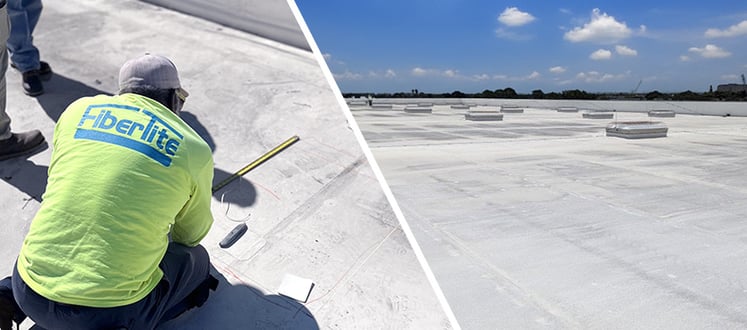
Single-ply roof membranes made from TPO, PVC and EPDM are some of the most commonly available and will generally provide acceptable performance if installed and maintained properly. For example, a basic roof membrane made from any of these materials can be expected to provide as much as a 20-year service life. But a more robust membrane—like FiberTite®—can deliver up to double that life expectancy.
For example, FiberTite single-ply membranes have recently received an industry-leading 40-year reference service life (RSL) through a cradle-to-grave environmental product declaration (EPD). Contributing to that rating is how FiberTite membranes provide excellent resistance to chemicals, punctures, abrasion, UV degradation, fire and other major threats that commercial roof systems face.
How does FiberTite outperform other membranes? Most roof membranes contain a densely knit polyester reinforcement layer, onto which the polymer coating is applied. The integrity of such a reinforcement layer can vary greatly from supplier to supplier. FiberTite membranes, by comparison, use a reinforcing fabric densely packed with fiber, providing exceptional durability. FiberTite membranes also use a polymeric plasticizer (KEE), which resists evaporation and extraction from long-term exposure to the elements, mitigating embrittlement that could otherwise result in failure.
For building owners, that all leads up to far fewer repair expenses over an extended service life, helping FiberTite Roof Systems deliver a lower total cost of ownership than other membranes.
Interested in learning more? Find out how you can benefit from a FiberTite roof system.
_width-790_height-444_name-thumbnail_image2 (1).jpg.jpg)